


When Does a Heart Blockage Need Angioplasty Instead of Medicines?
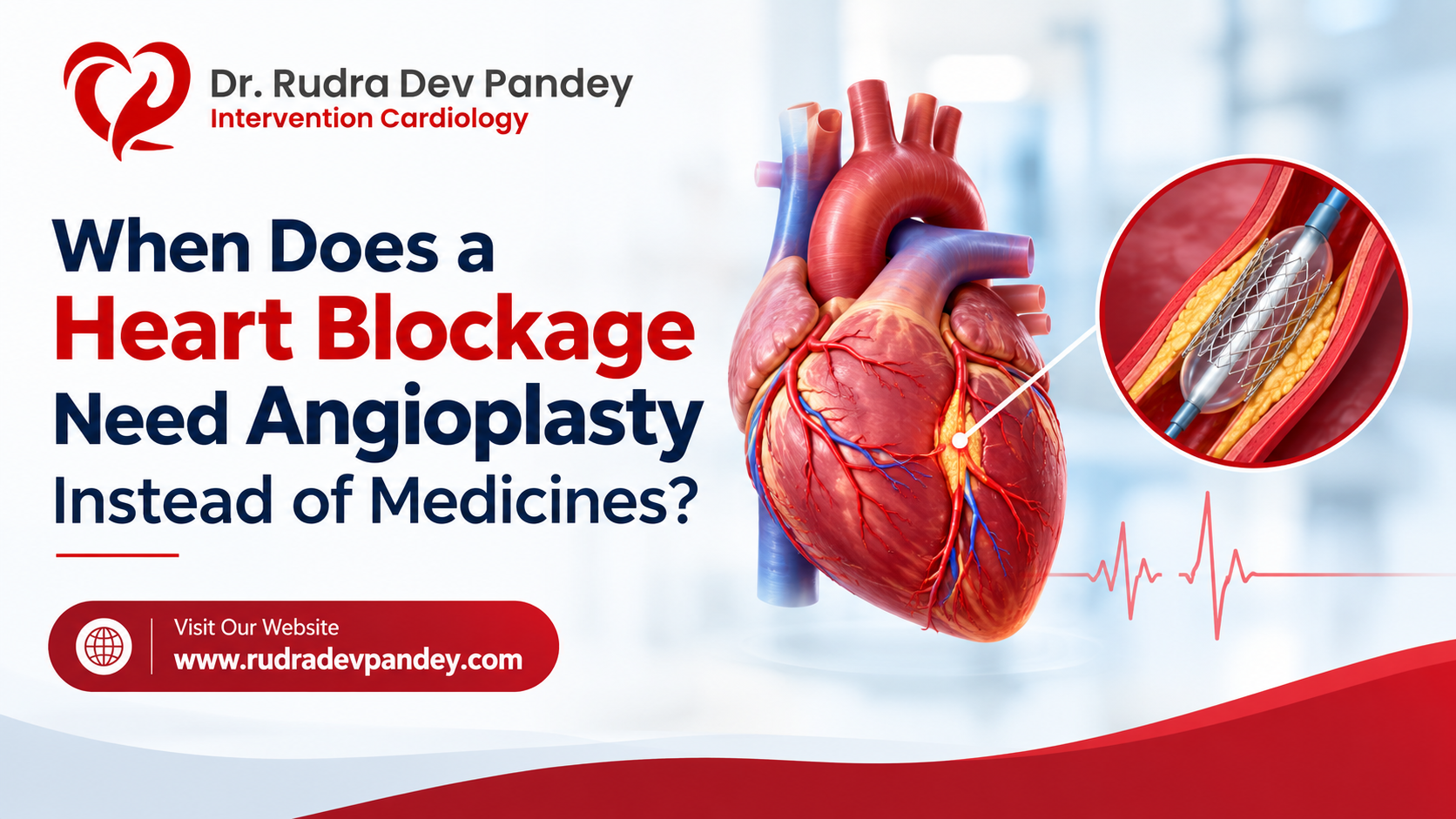
Discovering a heart blockage often leaves patients with one immediate question: “Do I need angioplasty, or can medicines control it?” The answer is not determined by the blockage percentage alone. Doctors consider the location of the narrowing, symptoms, blood flow to the heart muscle, test results, overall health, and whether the condition is stable or part of an emergency.
Medicines remain an important part of coronary artery disease management, but angioplasty may be appropriate when a significant blockage is causing symptoms or restricting blood flow despite suitable medical treatment.
What Exactly Is a Heart Blockage?
Coronary arteries carry oxygen-rich blood to the heart muscle. Over time, cholesterol, inflammatory material, and calcium can accumulate inside these arteries, creating atherosclerotic plaque.
As plaque increases, the artery may become narrower. Some people have no noticeable symptoms, while others develop chest pressure, breathlessness, or reduced exercise tolerance, particularly during physical activity.
A blockage seen on an angiogram does not automatically mean that a stent is required. The clinical significance of the narrowing has to be considered alongside the patient's symptoms and other investigations.
When Can Medicines Be Enough?
Many patients with coronary artery disease can initially be managed with medication and lifestyle changes.
Treatment may include medicines to control cholesterol, blood pressure, clotting risk, or symptoms, depending on the patient's condition. Stopping tobacco, improving diet, maintaining appropriate physical activity, and controlling diabetes can also be important.
If symptoms are controlled and there is no indication that a procedure would provide additional benefit, continuing medical management may be appropriate.
Regular follow-up allows the cardiologist to determine whether the treatment remains effective.
When Does Angioplasty Enter the Picture?
Angioplasty may be considered when a coronary narrowing is significantly affecting blood flow or producing troublesome symptoms despite appropriate medical management.
It can also become an urgent treatment when a coronary artery suddenly becomes blocked during an acute heart attack.
During angioplasty, a thin catheter is guided through a blood vessel toward the affected coronary artery. A balloon can be used to open the narrowed segment, and a stent may be placed to help maintain blood flow.
The procedure is performed according to the patient's specific coronary anatomy rather than simply because a particular percentage of narrowing has been reported.
Symptoms Are an Important Part of the Decision
A patient with a significant blockage but no symptoms may be managed differently from someone experiencing recurrent chest discomfort during minimal activity.
Symptoms such as pressure, heaviness, tightness, breathlessness, or reduced exercise tolerance can provide important clues about whether coronary disease is affecting daily life.
However, symptoms alone are not enough to decide on angioplasty. Doctors combine the patient's history with ECG findings, imaging, stress testing, coronary angiography, and other appropriate investigations.
Not Every Blockage Is Straightforward
Some coronary lesions are technically more challenging than others. Long blockages, heavily calcified arteries, bifurcation disease, chronic total occlusions, and disease affecting important coronary vessels may require specialized techniques.
An experienced Interventional Cardiologist in Jaipur can assess the coronary anatomy and determine whether conventional angioplasty is appropriate or whether additional techniques are needed.
In heavily calcified arteries, for example, plaque modification techniques such as rotational atherectomy or intravascular lithotripsy may be considered in selected cases.
What About Emergency Blockages?
The decision-making process can be very different during a heart attack.
When a coronary artery suddenly becomes blocked, the priority may be to restore blood flow rapidly. In an appropriate emergency situation, angioplasty can be performed to reopen the affected artery and reduce ongoing damage to the heart muscle.
This is different from stable coronary disease, where the treatment decision can often be planned after reviewing symptoms, investigations, and the patient's overall risk.
How Are Pacemakers Related to Heart Care?
Coronary blockages and electrical rhythm problems are different cardiac conditions, although they can sometimes occur in the same patient.
Some individuals may require device-based treatment because their heart rhythm becomes too slow or abnormal. Depending on the specific condition, options may include conventional pacemakers, cardiac resynchronization devices, implantable defibrillators, or leadless pacing systems.
For selected patients, a CRTD Pacemaker in Jaipur may be considered when reduced heart function is accompanied by specific electrical conduction abnormalities and there is an appropriate indication for resynchronization and defibrillation capabilities.
When Is an ICD Considered?
An implantable cardioverter-defibrillator, or ICD, is different from a standard pacemaker. Its primary role is to detect and treat certain dangerous ventricular rhythm disturbances.
Selected patients with significant heart-function impairment or a high risk of life-threatening ventricular arrhythmias may be evaluated for this type of device.
The term ICD Heart Surgery in Jaipur is sometimes used when patients search for this treatment, although ICD implantation is generally a device-based procedure rather than conventional open-heart surgery.
Whether an ICD is appropriate depends on the underlying heart condition, ejection fraction, rhythm history, and established clinical indications.
What Is a Leadless Pacemaker?
Traditional pacemakers use leads to connect the pulse generator with the heart. Leadless pacemakers take a different approach.
A small self-contained device is delivered through a catheter and positioned inside the heart. Because there is no conventional chest pocket or pacing lead, this technology may be suitable for selected patients with particular pacing requirements.
A Leadless Pacemaker in Jaipur may therefore be discussed when a patient's rhythm condition and anatomy meet the appropriate criteria.
Importantly, a leadless pacemaker does not treat a blocked coronary artery. Coronary disease and heart rhythm disorders require different forms of evaluation and treatment.
Dr. Rudra Dev Pandey's Approach to Cardiac Care
Dr. Rudra Dev Pandey, Senior Interventional Cardiologist and Director of Interventional Cardiology at Suvira Hospital, Jaipur, has extensive experience in coronary and structural heart interventions.
He holds MD (Medicine), DM (Cardiology), and FACC (USA) qualifications and has more than 15 years of experience in cardiology. He has performed more than 15,000 successful coronary interventions, primarily through the advanced transradial approach.
His areas of expertise include coronary angiography, angioplasty, complex coronary interventions, rotablation, TAVI/TAVR, pacemaker implantation, leadless pacemakers, MitraClip, device closure procedures, valve interventions, and other advanced cardiac treatments.
His treatment approach involves understanding the patient's symptoms, coronary anatomy, heart function, medical history, and overall risk before deciding whether intervention is appropriate.
What Should Patients Ask Before Choosing Angioplasty?
If angioplasty has been recommended, patients can ask their cardiologist:
- Where exactly is the blockage?
- Is it causing reduced blood flow?
- Are my symptoms related to this blockage?
- Could medicines manage my condition effectively?
- What are the benefits and risks of angioplasty?
- Will I need a stent?
- Are there other treatment options?
- What will recovery involve?
These questions can help patients understand why a particular treatment has been recommended rather than viewing angioplasty as an automatic response to an abnormal angiogram.
The Decision Is About the Whole Patient
There is no universal blockage percentage at which every patient needs angioplasty. A moderate narrowing can sometimes cause significant symptoms, while a severe-looking narrowing may not always require immediate intervention if it is not restricting blood flow in a clinically meaningful way.
That is why treatment decisions should be individualized.
Medicines, lifestyle changes, monitoring, and procedures can all have a role in coronary artery disease. When angioplasty is appropriate, careful assessment and experienced interventional care can help determine the safest and most suitable approach.

 English
 Arabic
 French
 Portuguese
 Deutsch
 Turkish
 Dutch
Dutch
 Italiano
 Russian
 Romaian
 Portuguese (Brazil)
 Greek
Greek