

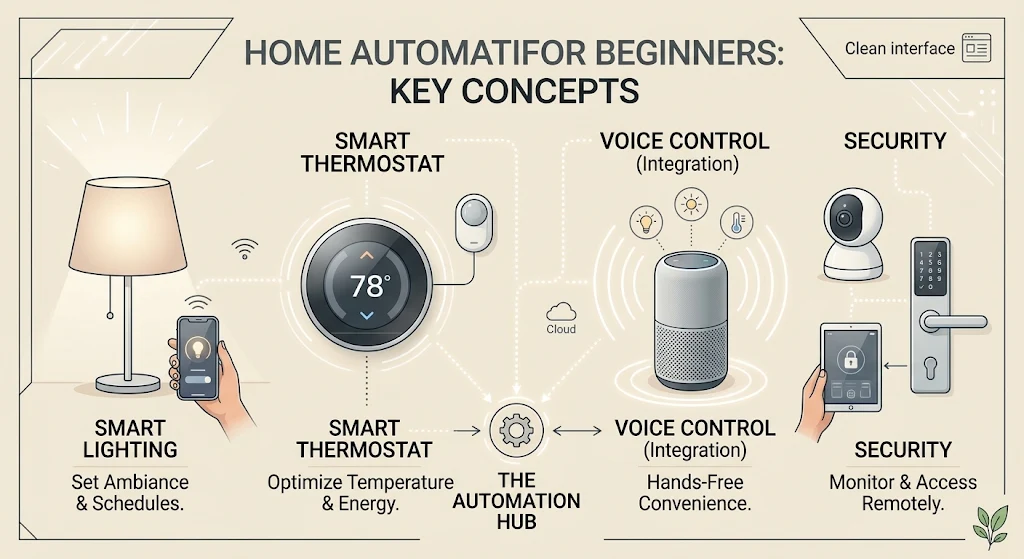
Total Home Automation for Beginners: Smart Lighting

When people hear "home automation," they often imagine expensive built-in systems, complex wiring, or the quirky voice-activated assistants from a sci-fi movie. But true total home automation starts with practical solutions that solve daily problems, and the single best, most cost-effective starting point is smart lighting.
Smart lighting is the gateway drug of home automation. It’s accessible, immediately satisfying, and opens the door to energy savings, enhanced security, and a more comfortable lifestyle. This guide breaks down the simple options for beginners.
The Two Primary Ways to Get Started
For a beginner, smart lighting generally comes in two main flavors, and the right choice depends on your long-term goals and budget.
Option A: The Smart Bulb (Easiest Entry)
This involves simply replacing your existing standard lightbulbs with smart bulbs. Products like Philips Hue, Wyze, or LIFX simply screw into any lamp or fixture. They connect directly to your Wi-Fi or a small, plug-in "bridge" device.
-
Pros: Requires no wiring; immediate setup. Great for rentals. Offers options for 'tunable white' (shifting from warm to cool) and full color.
-
Cons: Bulbs get expensive if you have multi-bulb fixtures. Critically: If you (or anyone else) turns off the physical wall switch, the bulb loses power and its "smart" capabilities.
Option B: The Smart Switch (Best for Whole-Room Control)
This involves replacing your standard, wired wall switch with a smart switch (like those from Lutron Caséta, Kasa, or Leviton).
-
Pros: Controls multiple bulbs; cheaper in the long run for full rooms. Your existing bulbs become smart, and the "always-on" wall switch ensures the connection is never broken. Best approach for high-ceiling recessed lights.
-
Cons: Requires basic electrical work (wiring). Rental restrictions may apply.
Simple Daily Practices with Smart Lighting
The true magic isn’t just controlling lights from your phone; it’s setting up "scenes" and "schedules" that simplify your day. Here are key beginner strategies:
-
The Schedule: Program your exterior lights (patio, driveway) to turn on automatically at sunset and off at sunrise. This enhanced security requires zero daily input. Program your bedroom lights to slowly brighten, mimicking the sun, on early mornings.
-
Voice Control: Integrate your smart bulbs with Google Assistant or Amazon Alexa. "Alexa, set mood to Movie Night" can instantly dim the living room lights to 20% and turn off the kitchen lights, creating an immersive experience without a single touch.
-
Voice Control: Connect a "Home/Away" feature. When your smartphone’s GPS signals that you are returning home, the front hallway light can automatically turn on, providing a warm and safe welcome.
Energy Savings & Long-Term Integration
Beginners should immediately configure motion sensor triggers. A simple Wi-Fi motion sensor placed in a hallway or a closet can ensure that lights are on when needed and—more importantly—off when they are not, leading to significant energy savings.
Furthermore, think about future expansion. Choose a platform that works well with others. Systems that support the new "Matter" standard, or integrate widely with both Google Home and Apple Home, will ensure that the smart light system you start today will seamlessly talk to the smart thermostat or door lock you decide to add tomorrow.
Conclusion
Don’t be intimidated by "smart home" complexity. Total home automation is about solving small problems. Start by automating your exterior lights or adding dimming voice control to your main living space. You'll quickly see how these small, connected steps transform your space, one light at a time.