

Why Your Coursework Reads Like Research Notes (Fix It)

You have read for hours. The folder is full of journal articles, the highlighter is nearly dry, and you know roughly what you want to say.
Then you reread your draft and something feels off.
One paragraph explains what Smith found. The next introduces Jones. A third brings in Brown. Before long, the assignment reads like research notes rather than an argument.
If that sounds familiar, the problem is rarely your reading. It is what happens after the reading.
Finding information and using it well are two different skills. Most students are never shown the second one properly. Markers see the result constantly: a margin note reading “so what?” beside a paragraph packed with citations.
Why Summary Feels Safe (and Why It Falls Short)
Take a student writing about employee motivation. They find papers on Maslow’s hierarchy, Herzberg’s two-factor theory and financial rewards. The natural move is one paragraph per theory.
Everything is relevant. Yet the discussion feels thin, because the theories have been explained but never used.
A stronger version asks whether meeting basic needs is enough to improve performance. It then sets that against Herzberg’s split between workplace conditions and genuine satisfiers. Now the theories are answering a question.
At Levels 4–6, you shift from explaining concepts to comparing arguments and weighing evidence. At Level 7, you are expected to question methods, challenge assumptions and explain why researchers disagree.
Students used to assessment that rewards explaining established knowledge can find this shift difficult. In UK higher education, accurate explanation matters, but you are also expected to build your own analysis and judge the evidence.
Your sources supply the material. The argument has to be yours.
Four Habits That Quietly Weaken a Draft
Keeping everything. After a long reading stretch, dropping a source feels like wasted effort.
Look at this: “Smith (2022) argues that engagement improves productivity. Jones (2023) identifies a link between engagement and performance. Brown (2024) highlights satisfaction.”
All accurate. But did they study similar workplaces? Did they measure the same thing? The reader gets information and has to build the connections alone.
A simple test helps. If a source adds nothing the others have not already covered, it can go. The reading still shaped your understanding, even if it never reaches the page.
Treating disagreement as contradiction. One study links remote working to higher productivity. Another reports communication problems. Before picking a side, check the design. One may have studied individuals, the other whole teams.
Thin paraphrasing. Swapping a few words for synonyms is not explaining. If your sentence still follows the original’s structure, you are standing too close to the source.
Careless citing. Some students cite after every sentence. Others hang one reference on a paragraph with five separate claims. Neither shows which evidence supports which point.
When examining examples from a Coursework Writing service, look beyond the finished paragraphs. Notice how claims are supported, how sources are compared and how the writer explains the evidence. Learn the method, then apply it to your own reading.
The Four Skills That Do the Real Work
Think of source use as four skills working together.
Description says what an author argued or found. You need it, but a paragraph that stops there is unfinished.
Analysis asks what the idea actually tells you. Does a higher salary really create satisfaction? Herzberg suggests recognition and responsibility matter more. You are now examining relationships, not repeating definitions.
Synthesis is the skill most often missing. Imagine three sources on online learning: one on engagement, one on tutor feedback, one on access to digital resources.
Instead of three paragraphs, show how they interact. Access allows participation, but participation does not guarantee understanding. Timely feedback may be what turns one into the other.
Critical evaluation connects the rest. Ask how long the study ran, who took part, and whether results came from exams or self-reported feelings. This is not fault-hunting. It is recognising what a study contributes and where its conclusions stop.
A Method You Can Use Tonight
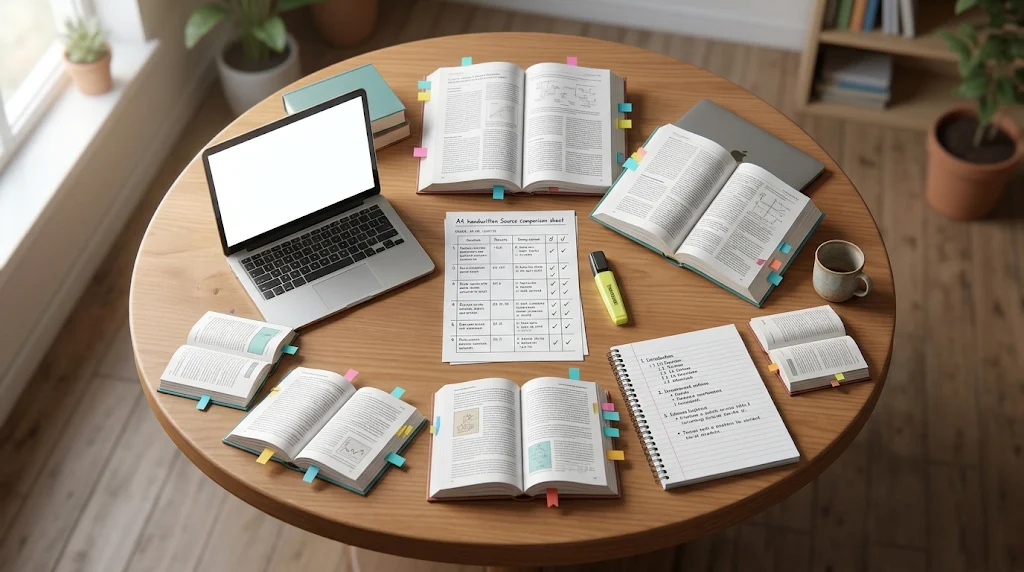
1. Build a source sheet. For each key source, write a line or two on its argument, evidence, method, limitations and relevance to your question. Keep it short.
2. Group by question, not author. Say your topic is flexible working and performance. Organise around three questions: does it help individual concentration, what happens to teamwork, and how does management shape the outcome?
3. Lead with your point. Open the paragraph with what it must establish: “Flexible working may raise individual productivity, although results depend on communication and management practice.” Then bring in the evidence.
4. Explain every finding. Compare these two.
Descriptive: Brown (2023) found flexible working improved satisfaction.
Analytical: Brown (2023) identifies a positive link between flexible working and satisfaction. Satisfaction alone, however, does not show higher productivity, so employee experience and organisational performance need examining separately.
5. Check your paraphrase. Read the passage, set it aside, explain it from memory, then check the meaning survived. Confirm each citation supports the claim it follows.
The Seminar Table Test
Here is a technique that makes comparison almost automatic.
Picture your sources round one table. Smith makes a claim. What would Jones say in response? Would Brown support it, add a different angle, or ask how Smith measured it?
Sources do not have to disagree to be useful together. One can support another, widen the picture or expose a limitation.
Write that exchange in two or three lines. For the flexible working topic, it might become: Smith finds gains in focus, but Jones’s team-level data suggests those gains come at a cost to coordination.
These lines often become your strongest analytical sentences, because they force comparison rather than listing. If your sources would have nothing to say to each other, they probably do not belong in the same paragraph.
Final Check Before You Submit
Read the last sentence of every body paragraph. Does it explain why the evidence matters, or just introduce another researcher? This one habit shows where your discussion needs work.
Read the draft aloud too. If you run out of breath in a sentence carrying four citations, split it.
Watch for claims wider than the evidence allows. A study of one organisation cannot describe every workplace. Where you can, read the original publication, because ideas drift through secondary sources.
Check your university’s guidance on Harvard, APA, MLA or OSCOLA, especially for secondary citations and direct quotations.
Bringing It Together
There comes a point where another source stops helping. You probably have enough evidence already. It just has not been connected.
So do not add five more references. Ask which sources support similar explanations, where they differ, and whether the gap comes from method, context or measurement.
Your sources give coursework its foundation. Your ability to question, compare and connect them gives it value.


